|
On what would be a humid summer day on July 5, 1852, Frederick Douglass stood at the podium of Corinthian Hall, a premier lecture hall in Rochester, New York, a city known for its abolitionist activism. Born into slavery, and self-liberated with the help of his wife Anna Murray Douglass, this leading voice in the abolitionist movement was invited to speak. July 5, 1852 was one day after the 76th anniversary of the signing of the Declaration of Independence. July 5th also marked the anniversary of an 1827 march in which Black New Yorkers walked through Manhattan to celebrate the abolition of slavery in New York State. For Douglass, delivering this speech on July 5th was intentional.
He believed celebrating the July 4th Independence Day while millions of Black Americans were enslaved, beaten, assaulted, and trafficked was the height of tyranny and injustice. The signing of the Declaration of Independence did not mean the end of chattel slavery, as notable signers, such as George Washington, James Madison, and Thomas Jefferson, themselves inflicted barbaric terror and legal ownership of hundreds of men, women, and children. With some 600 people in attendance, a 34-year-old Douglass stood facing the audience and delivered one of the most prolific speeches in history. What to the Slave is the Fourth of July?
What, to the American slave, is your 4th of July? I answer; a day that reveals to him, more than all other days in the year, the gross injustice and cruelty to which he is the constant victim. To him, your celebration is a sham; your boasted liberty, an unholy license; your national greatness, swelling vanity; your sounds of rejoicing are empty and heartless; your denunciations of tyrants, brass fronted impudence; your shouts of liberty and equality, hollow mockery; your prayers and hymns, your sermons and thanksgivings, with all your religious parade, and solemnity, are, to him, mere bombast, fraud, deception, impiety, and hypocrisy, a thin veil to cover up crimes which would disgrace a nation of savages. There is not a nation on the earth guilty of practices, more shocking and bloody, than are the people of these United States, at this very hour.
At the podium to a majority white audience, he told the truth, that Black people lifted the United States in every enterprise; such as doctors, lawyers, teachers and poets; despite racial terror and oppression. Black people were organizing, self-liberating, and writing their own futures, even under a federal government that passed the Fugitive Slave Act, which made all parts of the United States unsafe for Black families. Douglass gripped and examined the soul of America and its relation to the world.
But a change has now come over the affairs of mankind. Walled cities and empires have become unfashionable. The arm of commerce has borne away the gates of the strong city. Intelligence is penetrating the darkest corners of the globe. It makes its pathway over and under the sea, as well as on the earth. Wind, steam, and lightning are its chartered agents. Oceans no longer divide, but link nations together. From Boston to London is now a holiday excursion. Space is comparatively annihilated. Thoughts expressed on one side of the Atlantic are, distinctly heard on the other. The far off and almost fabulous Pacific rolls in grandeur at our feet. The Celestial Empire, the mystery of ages, is being solved. The fiat of the Almighty, “Let there be Light,” has not yet spent its force. No abuse, no outrage whether in taste, sport or avarice, can now hide itself from the all-pervading light.
Douglass was speaking of a global community; one that is connected in knowledge and innovation. One in which countries hold each other accountable for the sake of all humanity. His hope and demands for freedom and liberty is still an urgent call for action. Through his words for U.S. and global responsibility, we can easily see Douglass at a podium in 2026 speaking out and working to end genocide for the people of Gaza and Sudan.
As a Black woman and museum professional, I have found moments of inspiration this commemorative year, though it has also been painful. We witnessed the relentless adultification of and assault on Black youth; organizations and corporations scrubbing their websites and programming of Diversity, Equity, and Inclusion (DEI) rhetoric; the further gutting of the Voting Rights Act; cuts in funding; and the erasure of Black history from our national heritage sites, schools, and libraries. Amid an America250 celebration, on the White House lawn, we watched the racist affront against the nation’s first Black First Lady.
But amidst the attacks were the profound artists, young people, educators, historians, descendants, HBCUs, and museums across Maryland and the country who did not back down. Those who continue to discover, document, and share Black history, art, and culture; creating new repositories, libraries, and community spaces. From the development of the AFRO Archives in Baltimore City, the opening of Freedman’s State Park in Montgomery County to the reopening of The Studio Museum in Harlem and the grand opening of The Barack Obama Presidential Center in Chicago, these accomplishments are not a reaction to a political moment. This work is rooted in the education and empowerment of today’s and future generations.
And as July 4th, Independence Day, approaches its 250th anniversary, remember: you belong here. Whether or not you were born here, whether or not a president, banners, or parade recognizes your humanity and heritage, we are America. Despite efforts to roll back our civil rights that ancestors fought for, we will continue to tell our stories. We will continue to build libraries and museums; preserving and cultivating our scholarship, genius, and art forms. As Douglass states, No abuse, no outrage whether in taste, sport or avarice, can now hide itself from the all-pervading light. We will continue to advance restorative justice, healing, love, and reparation. And to the descendants of the African diaspora – your reflection says what a young Langston Hughes wrote at his typewriter in Harlem, decades after Douglass’ galvanizing speech:
…They’ll see how beautiful I am
And be ashamed—
I, too, am America.
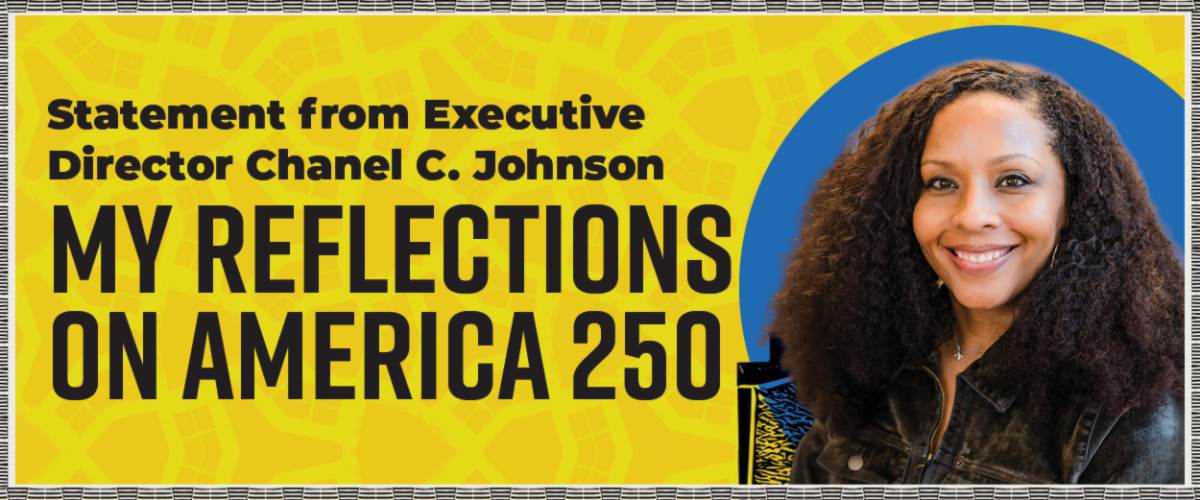
Chanel C. Johnson
Executive Director
|

 1-888-373-7888
 233733